





1. What is Internal Communication?
Internal communication is a form of information exchange between two or more individuals, consciously and unconsciously, by verbal and non-verbal methods, directly and indirectly, depending on the purpose of each individual and organization.
Internal communications (IC) is the function responsible for effective communications among participants within an organization. The scope of the function varies by organization and practitioner, from producing and delivering messages and campaigns on behalf of management, to facilitating two-way dialogue and developing the communication skills of the organization’s participants.
Internal communication is meant by a group of processes that are responsible for effective information circulation and collaboration between the participants in an organization. Modern understanding of internal communications is a field of its own and draws on the theory and practice of related professions, not least journalism, knowledge management, public relations (e.g., media relations), marketing and human resources, as well as wider organizational studies, communication theory, social psychology, sociology and political science.
2. How many sources of internal communication?
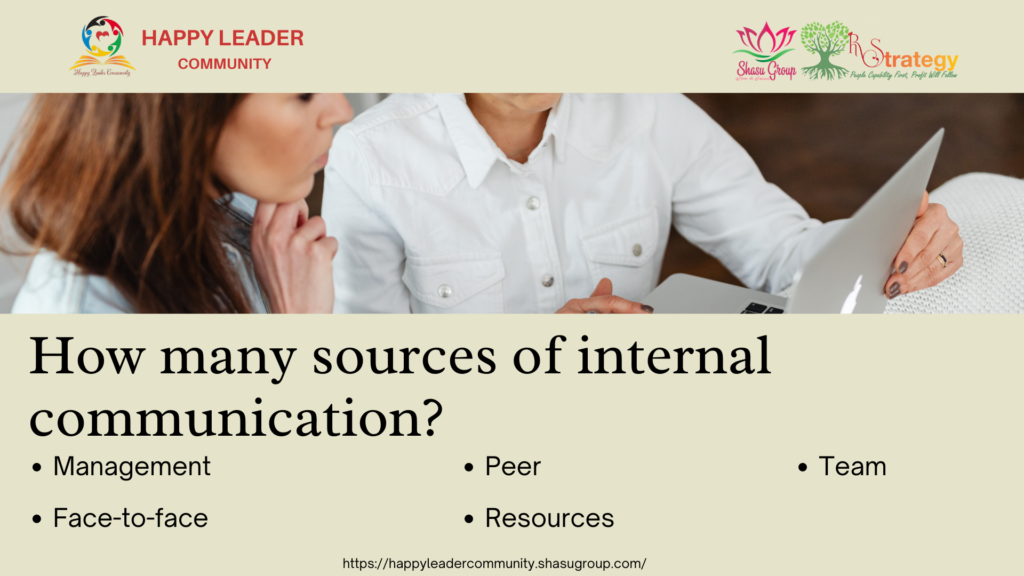
There are five main sources of internal communication:
- Management – who dispense information such as strategies, company results, internal and external information, and other important general information.
- Team – between colleagues who work together to achieve the same end goal.
- Face-to-face – briefing individuals on tasks and situations.
- Peer – informal chats between colleagues to share information.
- Resources – the intranet, email, social media, messaging, video calls, telephone.
Each of these types uses a specific channel to achieve its internal communication goal:
- Verbal – the passing of information by word-of-mouth.
- Electronic – how most information in writing is shared.
- Paper – a way of communicating using posters and graphics.
3. 4 Types of Content for your Employees to create Internal Communication:

Having your employees share your content on their social media networks is the perfect way to increase your organic reach. But what type of content are your employees likely to share?
- Content About Them
People like to share content about them or content that shows them in a good light. Software company MuleSoft does this well by regularly publishing profiles of their employees, like this profile of one of their services engineers.
In addition to being the type of content employees like to share, this type of content also helps to humanize your brand, making you more relatable and likable.
- Content They Helped Create
People enjoy feeling they are part of a community, and your employees are no different. When you ask employees to get involved in the creation of your content, it gives them ownership and a sense of pride over the finished product. This, in turn, makes them more likely to share the final product. A Finnish company ZEF created a video where their “Customer Happiness Expert” interviewed a career consultant regarding emotions in the workplace. Then there’s the “Made the Johnsonville Way” initiative, where employees shared their ideas for a Johnsonville Sausage ad. Both of these companies involved their employees in the content creation process, which makes them more likely to share the content on their own social media pages in a natural way.
- Content That Makes Them Feel Proud
Employees share content on their social media account because they like how it reflects upon them. Content that makes them feel proud of their company, or even makes their friends a little jealous, is far more likely to get shared.
Take for example, Finnish company DNA wrote about an award they were given to by The Federation of Families for being the most family-friendly company. Or ZEF, whose tool was used to help educate Icelandic voters about their options in upcoming elections.
- Content About Experiences They Enjoyed
Open up your Facebook or Instagram newsfeed and you are likely to see your friends sharing pictures of their dinner at a new Pho restaurant, a St. Patrick’s day party they attended, their kids at the zoo, or their vacation to New Zealand.
What do all these examples have in common? They document experiences. We like to share proof of experiences we enjoyed. For brands, this might include content like photo booth shots from a recent conference or pictures from the company holiday party.
BBDO, an advertising company based in Belgium, does this well by sharing images of their company’s yearly holiday party.
Search Engine Journal, a digital marketing publication, shares pictures from meetups, parties, and conferences.
Other examples might include recap posts about conference sessions, videos from an industry event, or behind the scenes pictures from your office.
4. Final Thoughts
Your internal communication has a great impact on employee productivity, the employee experience you deliver, employee engagement and ultimately your employee advocacy strategy.
The key is to build an internal communication strategy that involves everyone within the organization: top management, managers and employees.
Organizations that have a solid internal communication strategy in place are better equipped to have superior conversations with employees around performance, experience and engagement.
Remember, your informed and engaged employees are your best brand ambassadors!
Trân trọng
Đồng hành & cho nhau giá trị
BQT Happy Leader Community


